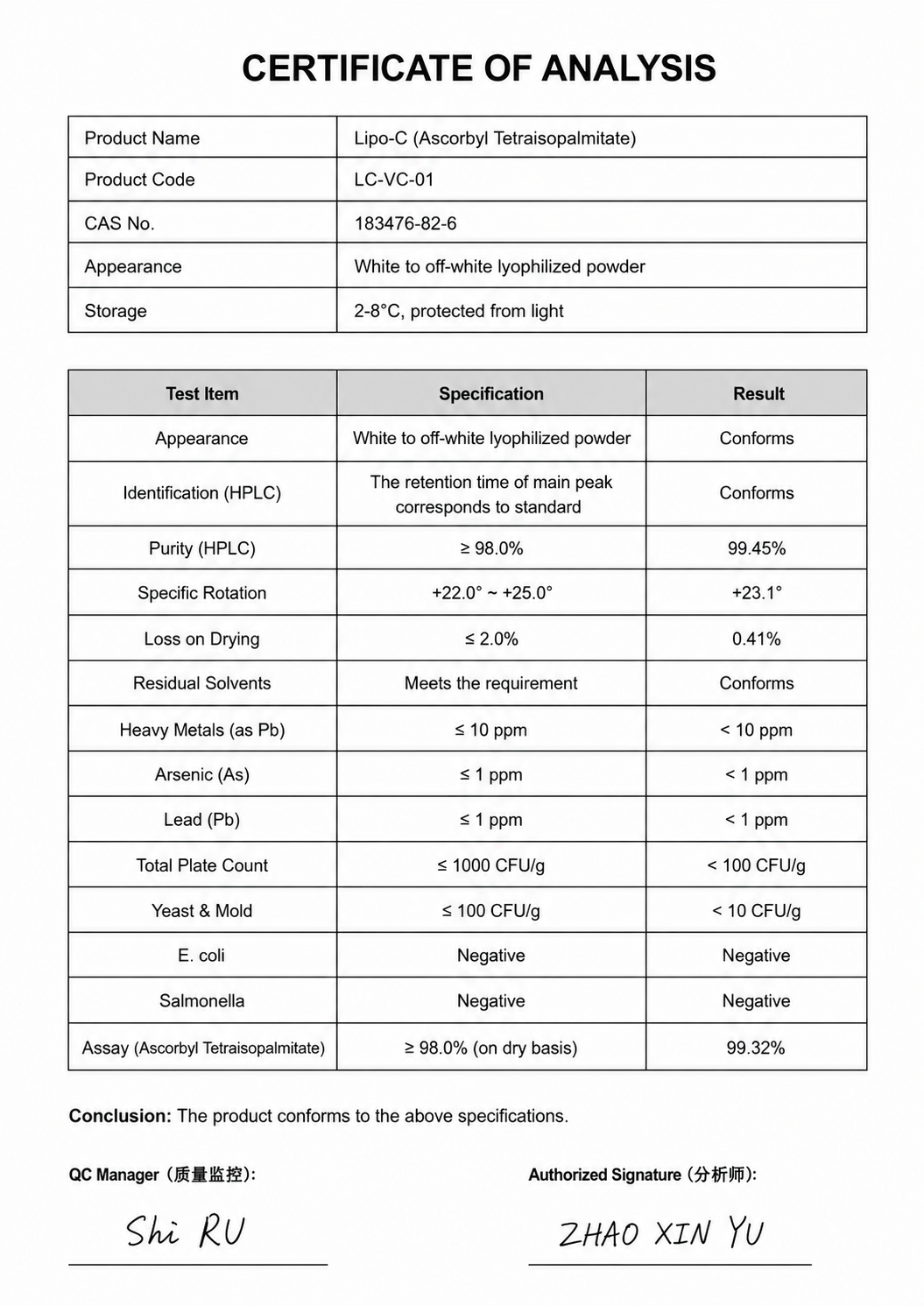
COA in Progress
Scientific Background & Mechanism
Lipo-C — Research Guide / COA Information
Mechanism of Action / Scientific Background
Lipo-C is a formulation name rather than a single standardized chemical entity, so its biochemical properties depend on the specific active ingredients and their concentrations. Research interpretation should therefore be based on the documented composition of the individual batch.
Where a Lipo-C formulation contains vitamin C or other defined compounds, laboratory investigation may examine their physicochemical properties, stability, redox behavior, molecular interactions, and effects in validated in-vitro or analytical models. Any mechanism-of-action discussion should correspond specifically to the verified ingredients rather than being generalized from the Lipo-C product name.
Research Applications
Potential laboratory research areas may include:
Analytical characterization and compound identification
Purity and content/assay determination
Formulation and stability studies
Oxidation and degradation studies
Solubility and compatibility testing
In-vitro biochemical research
Chromatographic or spectrometric characterization
Comparative formulation research
The appropriate research application depends on the actual composition of the tested material and the experimental protocol.
Laboratory Reconstitution Reference
For laboratory research only. If the supplied research material requires preparation or dilution, use an appropriate laboratory solvent or buffer validated for the specific analytical method and compound composition.
Use calibrated laboratory equipment and aseptic or controlled handling procedures where required by the research protocol. Record the solvent, final laboratory concentration, preparation date, lot number, and relevant experimental conditions in the study documentation.
Prepared research samples should be handled according to compound-specific stability data and the laboratory's validated procedures.
No human or veterinary dosing or administration instructions are provided.
Storage
Store according to the conditions established by the product specification, stability data, and accompanying laboratory documentation. Protect the material from conditions known to affect the stability of its verified ingredients, which may include excessive heat, moisture, or light.
For prepared laboratory samples, use storage conditions supported by the applicable experimental protocol or validated stability study. Avoid repeated environmental exposure when it may compromise sample integrity.
Scientific References
Because Lipo-C is not a standardized scientific compound name, references should be selected according to its verified formulation. Appropriate sources can include peer-reviewed literature on the individual active ingredients, validated analytical methods, stability research, and authoritative chemical databases.
Once the exact Lipo-C ingredient list is established, this section should contain full citations relevant to those specific compounds rather than references to “Lipo-C” generically.
Research Use Only — Not for Human Consumption. Not intended for medical, diagnostic, therapeutic, cosmetic, or veterinary use.
Certificate of Analysis